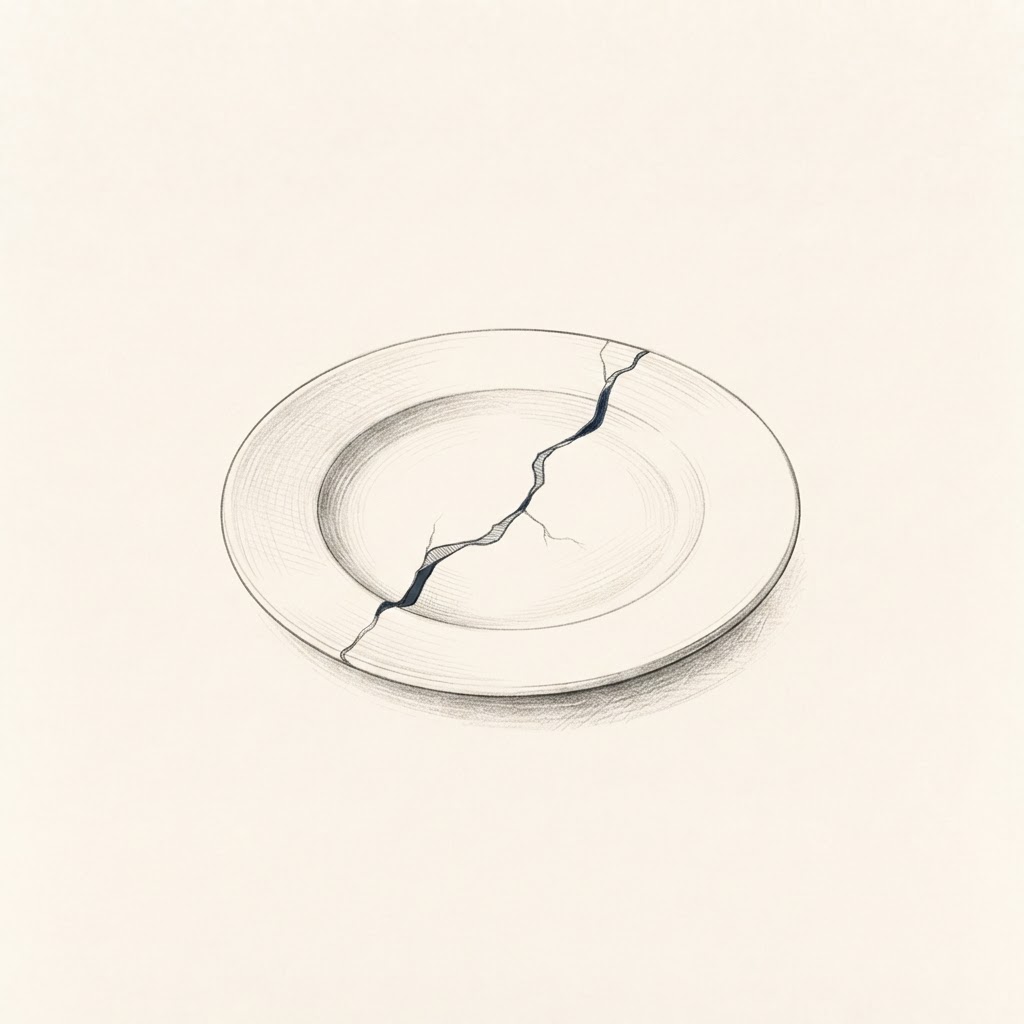
You sit down to write about the conversation and you realize you can't quite reconstruct it. Not the content—some of that you remember—but the sequence. The moment where you got confused. The point where the subject changed without you noticing. The specific thing he said that made you feel like you'd done something wrong before you'd figured out what it was.
In the room, in real time, you were trying to listen, trying to understand, trying to respond reasonably to someone who seemed to be in genuine distress. You missed ninety-three things.
You can't be objective about a conversation you're inside. It's structurally impossible. You are your experience. There is no vantage point outside yourself that's available while you're having an emotion.
Which is why you record it.
Not for him. For you.
This is important. The recording is not ammunition. You're not going to send it to him and say: see, I told you. Listen to yourself. You did a thing.
That's not what it's for. It's for you to listen to later, when the emotion has dissipated and you can hear what you couldn't hear in the room. Because you will hear things that didn't register in real time.
The passive-aggressive comment wrapped in a laugh that you let go because you were trying to stay focused on the main point. The moment the subject shifted and you didn't notice because you were still responding to the previous thing. The dig, and then another dig, and then another, stacking up while you were trying to understand the argument at the surface level.
You can't count what you didn't catch. The recording catches it. Not to prove something to him. To show yourself: this is what the conversation actually contained, separate from what it felt like to be in it.
What you'll hear when you play it back.
The sequence. That's the main thing. Arguments in these dynamics almost never stay on the thing they started about. They migrate—toward your vulnerabilities, toward the past, toward something that will get a bigger reaction than the original topic. In the room, the migration feels like the natural course of a difficult conversation. On the tape, you can hear it happen.
And then you can identify the moment—the specific moment—where you got moved. Where the original thing you brought got replaced by something he introduced. Where you started defending yourself instead of the point you came in with.
That moment is the information. That's the place the old pattern fires. And when you can hear it clearly, separate from the emotion of being in it, you can start to learn what it feels like just before it happens. Which is when you can do something different.
The note on the wall.
She had two notes. Hers said Record. His said Remember, we love each other.
Two different operating principles in the same room. One aimed at clarity. One aimed at control. Knowing which is which doesn't make the room less hard. But it means you're no longer confused about what you're inside.
The tape is for you. It's how you become objective about something you can't be objective about in the moment. Not evidence. Not ammunition. A mirror, played back when the emotion is gone and you can finally hear what was actually there.